What Is Co-Selling? The Complete Guide for B2B Alliances Teams
Co-selling is the practice of two companies' sales teams jointly pursuing a shared account. This guide covers how it works, why it closes faster, and how to automate the workflow.
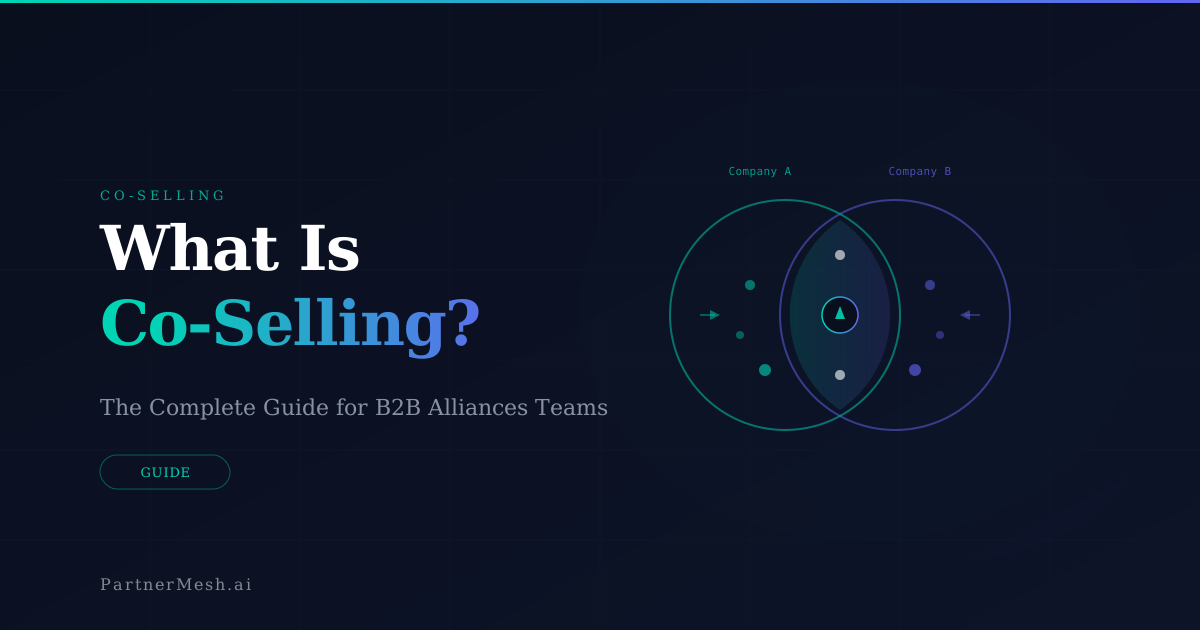
Co-selling is the practice of two companies' sales teams working together to close a deal with a shared account — each bringing their unique credibility, customer relationship, or product capability to the opportunity. In B2B SaaS, co-selling typically happens between technology partners whose solutions integrate or complement each other, and it is one of the fastest ways to compress deal timelines because the trust gap that normally slows a cold sales motion has already been bridged. For alliances managers, building and running a repeatable co-sell motion is the core job — and the difference between a partnership that generates measurable revenue and one that exists only on paper.
What Is Co-Selling?
Co-selling is a joint sales motion between two companies pursuing the same account. One or both companies bring sales resources into a deal to support the other's sales process. The result is a deal that moves faster, wins more often, and often lands at a higher contract value than either company would have closed independently.
In practice, co-selling looks like this:
- Company A's AE is working a prospect that already uses Company B's product
- Company B's partner manager introduces Company A's rep as a trusted integration partner
- The prospect, already confident in Company B, extends that trust to Company A
- Both companies advance the deal together, sharing intel on stakeholders, timing, and objections
This is the mechanic. The trust transfer is what makes co-selling materially different from cold outreach or even inbound marketing.
Why Co-Selling Works
Partner-sourced deals close 46% faster than cold outreach because the credibility problem has already been solved. The prospect doesn't need to research and evaluate you from scratch — your partner's existing relationship serves as the proof point.
Companies with mature ecosystem programs generate 26% of their pipeline through partner sources. That is pipeline that would not exist without the co-sell motion.
The Three Types of Co-Selling Motions
1. Partner-Sourced Co-Sell
Your partner identifies an opportunity in their customer base or pipeline where your solution is a strong fit, and brings you into the deal. This is the highest-value co-sell motion because you are entering a relationship where your partner already has established trust.
2. Parallel Co-Sell
Both companies are independently pursuing the same account. One or both discover the overlap and decide to coordinate rather than compete or operate independently. This happens most naturally when both companies are in the same deal cycle and the prospect is evaluating an integrated stack.
3. Influenced Co-Sell
Your partner is not directly selling but provides an introduction, reference, or strategic endorsement that meaningfully moves the deal. This is softer than the first two motions but measurable — and often the mechanism that breaks a stalled deal.
How a Co-Sell Motion Actually Runs
- Account overlap identification — Your CRM account list is compared against your partner's to find shared accounts, done securely without handing your full CRM export to your partner.
- Opportunity qualification — Not every overlap is worth pursuing. The best co-sell targets are accounts where both companies' solutions are clearly complementary and where there is an identifiable business trigger.
- Co-sell room activation — The two reps connect in a shared workspace. PartnerMesh automates this: when an overlap is flagged, a co-sell room is created automatically with the account context pre-loaded.
- Joint outreach or introduction — One rep makes the introduction, or both coordinate outreach with aligned messaging.
- Deal coordination — Both reps stay aligned through the deal cycle — sharing stakeholder intel, coordinating demo timing, and supporting each other's close.
- Attribution — When the deal closes, it is tagged as partner-sourced or partner-influenced in the CRM.
What Kills Co-Sell Deals
Manual coordination overhead. If the process for starting a co-sell motion is "email your partner manager and see if their AE responds," most deals will die in the coordination phase.
No shared workspace. Reps from two different companies trying to co-sell through their respective internal Slack instances and email threads create confusion and dropped balls.
No overlap detection. If your team doesn't know which of your partner's accounts are in your pipeline, you can't initiate the co-sell.
No attribution. If partner-sourced revenue is invisible in the CRM, there is no business case for investing in co-sell infrastructure.
Building a Repeatable Co-Sell Motion
Infrastructure: A tool that automates account overlap detection and co-sell room creation. The manual version does not scale past two or three active partner relationships.
Process: A defined playbook that specifies who qualifies overlaps, how co-sell rooms are activated, who makes the introduction, and how deals are tracked and attributed.
Incentives: Both your reps and your partners' reps need a reason to prioritize co-sell deals.
Frequently Asked Questions
What is the difference between co-selling and reselling?
Reselling is when a partner sells your product on your behalf, typically at a margin. The partner owns the customer relationship and the transaction. Co-selling is when both companies' sales teams work together on the same deal — neither is reselling for the other. In a co-sell motion, both companies typically have a separate commercial relationship with the end customer.
What is a co-sell room?
A co-sell room is a shared workspace — typically a Slack channel or deal room — where reps from two different companies coordinate on a joint opportunity. PartnerMesh automatically creates a co-sell room in Slack whenever a new partner overlap is detected, pre-populated with account data from the CRM.
How many partners can you co-sell with at once?
Without automation, most alliances teams can actively co-sell with three to five partners before the manual coordination becomes a bottleneck. With automated overlap detection, co-sell room creation, and joint proposal generation, the ceiling is substantially higher.